Technology
A quantum sensor in diamond, read with light.
A nitrogen-vacancy (NV) centre is a defect in diamond that behaves like a tiny compass you read with light. It works at room temperature, and the crystal lattice gives it a sense of direction. We design instruments around it, navigation first.
The principle
How a diamond reads the Earth's magnetic field.
Three steps, from the map to the spin. No equations.
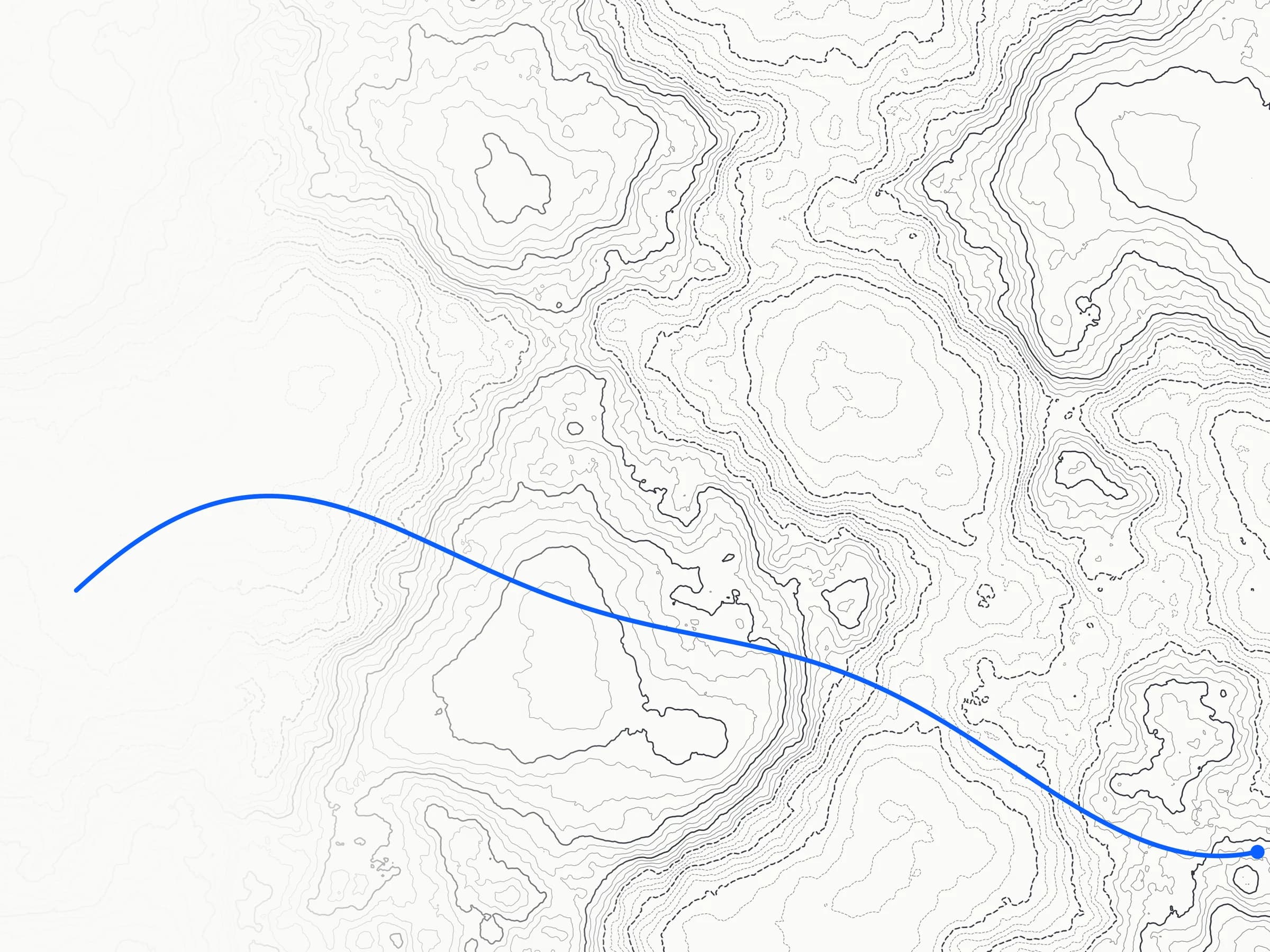
Illustration: a magnetic relief, and a route across it. Step 1: The Earth has a fingerprint
Magnetic rocks in the crust distort the Earth's field, a little differently everywhere. Much of that relief has been mapped, from the air and at sea, more finely in some places than in others.
Step 2: Resonance, as in MRI
An NV centre, a defect in diamond, carries a spin that microwaves drive into resonance, as in an MRI scanner. Green light in, red light out: the red glow dips at the resonance frequencies, and the field shifts them. Where the dips sit gives the field.
Step 3: Spin coherence
Like a spinning top, the spin turns around the field, faster when the field is stronger. Keeping that beat is called coherence: the longer it lasts, the finer the measurement.
Why diamond
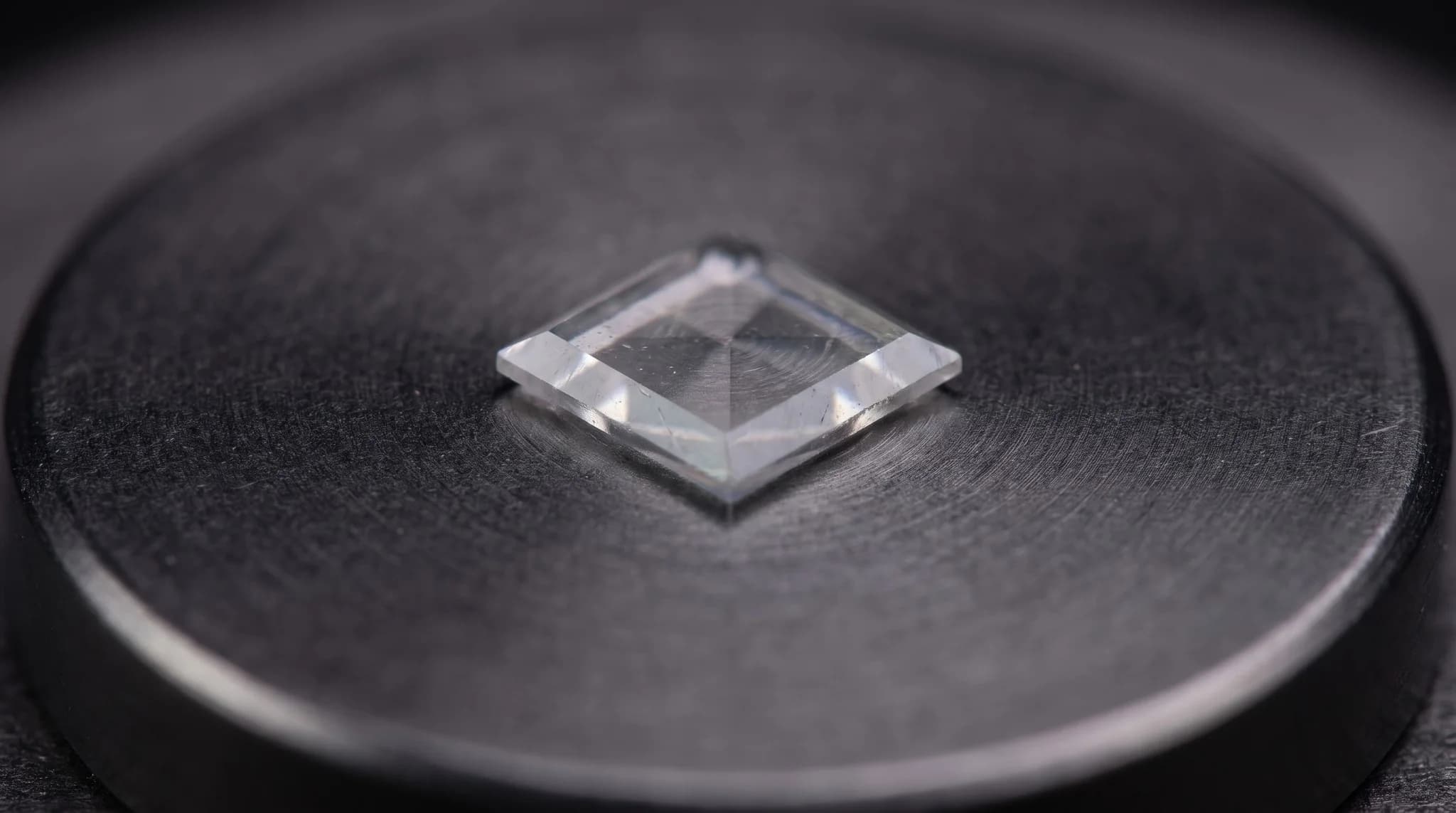
Room temperature. Survives the platform. Four crystal axes.
What this means on a vehicle
No cryogenics
The NV centre works at room temperature, with no vacuum and no consumables.
Survives the platform
Shock, vibration, radiation: the sensing element is a solid crystal. We design the sensor head around it to ride on the vehicle.
No external signal
Passive: it reads the Earth's own field and needs no external signal. A magnetic source placed nearby can disturb a magnetometer. The instrument is designed to detect that and say so.
Four crystal axes: the vector comes from the lattice.
In diamond, an NV centre points along one of four directions fixed by the crystal lattice. Each direction senses the part of the magnetic field that lies along it.
Read together, they give the full vector: its strength and its direction.
By requirement
What a vehicle asks of a magnetic sensor.
Others flew NV sensors before us. Diamond brings the first three answers, and how well it brings them depends on the material, which is part of our work. The last two depend on how the instrument is designed.
- Run without cryogenics
- Room temperature, nothing to refill.
- From: The material
- Ride through vibration and shock
- A solid crystal, carried by the sensor head.
- From: The material, then the head design
- Measure the field as a vector
- Four crystal axes: the vector comes from the lattice.
- From: The material
- Keep the vehicle's own field out
- The instrument rejects the platform's own magnetic field on board.
- From: The instrument design
- Say how far each position can be trusted
- Every fix comes with its error bound.
- From: The instrument design
Qualitative. Whatever depends on our design, the sensor head included, is design intent until shown on hardware.
Where we stand →Simulation first
Every design flies in simulation first.
Before any hardware, we simulate the whole chain: the magnetic terrain, a vehicle with its own magnetic field, the sensor and the navigation filter. A small team can compare designs this way before anything is fabricated.
To be calibrated, useful in relative terms.
The simulation tells us which design is better, not what a prototype will measure. Its figures are labelled model-derived, and hardware measurements will calibrate it.
100+
published experiments in our validation register
Quantitative validation covers the subset whose experimental conditions are documented well enough, and the list is available on request.
When the model and an experiment disagree, the experiment wins and the model changes.
How the register is kept →Where we stand